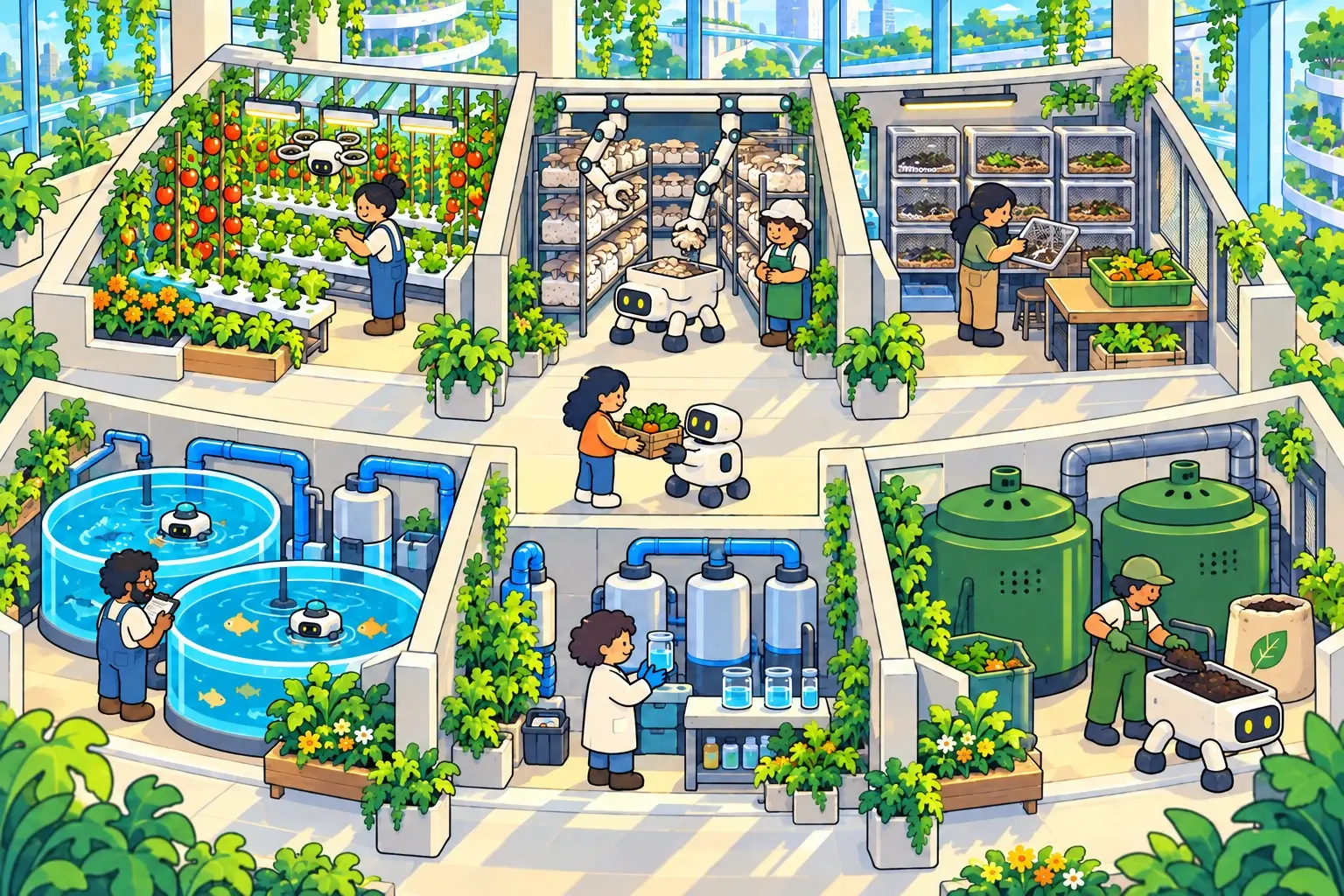
Follow the garden into the rooms that keep it growing.
Mel’s marigolds are one small part of a much larger exchange. Step behind the garden: meet the growers, follow the water, and discover what can become food again.
Choose a room to look closer.Illustrated cutaway · Not to scale
A proposed farm cluster serving the neighborhood of Floor 318. The rooms, scale and connections are an architectural study, not a confirmed floor plan or a claim of food self-sufficiency. Roofs, front walls and doors are omitted for visibility; production rooms would have controlled boundaries.
Nothing disappears into an arrow
Follow an exchange.
Food, water and residues take different paths. Choose one to see what travels, what is checked, and where it stops.
Two recirculating circuits. One controlled exchange.
01
Fish water → water care
Separate solids, process dissolved nitrogen waste and maintain oxygen.
02
Water care → fish
The fish circuit recirculates locally; it does not depend on plant drainage.
03
Tested transfer → hydroponics
A controlled amount moves one way. Adjust the plant reservoir for the crop’s needs.
04
Plant reservoir → plants → reservoir
Plants have their own recirculation, replenishment and nutrient management.
Fish life support and plant irrigation operate separately. Nutrient transfer can stop without making either circuit depend on the other’s return water.
Try a design decision
What if we pause the fish-to-plant transfer?
A demonstration of the proposed plumbing logic. This is not a live farm simulation.
Transfer available. Only checked water moves into the plant circuit. No plant drainage returns to the fish.
Where does it all fit?
Close neighbors. Separate environments.
One floor is a sensible starting point for this neighborhood. A larger food system may need a cluster of adjacent decks. Neither arrangement requires one shared water loop.
Shared farm deck
Plants & soil gardenMushroomsInsectsFishWater careRecovery bay
Arrangement study · No floor numbers or dimensions assigned
Begin with a compact cluster.
Short service runs and nearby growers simplify inspection and exchange. Fish, plants, mushrooms and insects still need distinct operating conditions; composting belongs behind a controlled service boundary.
What it makes easier
Maintenance access, short transfers, shared staff and a clear relationship between the garden and its support rooms.
What it costs
A large contiguous area, concentrated water loads, and careful separation of humidity, odors, pests and clean produce handling.
Before choosing
Calculate crop area, diet contribution, water and nutrient balances, structural loads, light, cooling, labor and failure recovery. A one-metre depth of water alone adds about one tonne per square metre; tanks and equipment add more.
Our design inference, informed by separate-loop trials and hydraulic design research. It needs site-specific engineering. Larger composting and digestion may be shared city utilities.
From the drawing into the world
Who is building pieces of this?
Real companies, organized by room. Follow a link to the equipment, the grower or the trial behind it. These examples support individual parts of our proposal; the complete Arcology farm has yet to be demonstrated.
AI makes predictions or guides decisions. Robotics moves and handles things. Process automation controls equipment. They can work together, but one does not imply the others.
Models help growers plan cultivation, forecast harvests and control irrigation.
Grower use reported
Deployment & fit: Source.ag
Source describes Rainbow Growers Middenmeer using its irrigation control with peppers, including the growers’ experience of the pilot.
A greenhouse comparison. The case describes pilot experience and grower oversight; it does not validate our mixed crops or promise better flavor or nutrition.
ReelAppetite detects uneaten pellets in tank outflows and adjusts connected feeders.
Commercial trial; expansion contracted
Deployment & fit: ReelData
An October 2024 announcement describes over a year of use at Samherji’s Staður charr site, followed by an agreement covering three sites. The agreement alone does not confirm every installation was completed.
Relevant to land-based tanks. This is camera-and-feeder automation, not the illustrated floating robot; performance must be checked for our species and water conditions.
SmartOps uses operating data to model water-treatment performance and recommend adjustments.
Commercial use reported
Deployment & fit: Gradiant / Turing
Gradiant’s ENGIE case describes machine-learning recommendations at a Middle Eastern seawater desalination plant, online in 2021. Operators entered the recommended settings.
Evidence for AI assisting water-plant operations. Desalination is a different process from aquaponic biofiltration or safe nutrient transfer; no savings percentage is carried into our design.
Pearl reactors recover phosphorus in struvite fertilizer granules from suitable wastewater streams.
Commercial installation documented
Deployment & fit: Ostara
Ostara and Chicago’s MWRD opened a nutrient-recovery facility at the Stickney plant in May 2016.
A supporting recovery process, not an AI or robotics example. Municipal wastewater differs from fish solids; this does not establish direct reuse in hydroponics or recovery of every nutrient.
Protix describes commercial production and a Dutch blueprint plant opened in 2019. Its operations page identifies AI and robotics among the technologies it uses.
Protix explicitly reports using AI and robotics, but the reviewed pages give limited detail on their individual tasks or measured contribution. Suitable feedstocks and fish-diet formulation remain separate questions.
Sensors and controls regulate aeration, surface irrigation and process records during composting.
Commercial use reported
Deployment & fit: Engineered Compost Systems
ECS describes its CompTroller installation at Napa Recycling and Waste Services, processing yard and food waste. The case includes finished compost supplied to agriculture and community gardens.
Conventional process automation, not a verified AI system. It supports managed composting and batch records, not our bucket-carrying quad or a promise of instant mature compost.
A compost producer helped develop autonomous electric compost turning with Pusch & Schinnerl and university partners.
Prototype tested in an industrial setting
Deployment & fit: Sonnenerde
The ANDREA project names Sonnenerde as coordinator. The researchers’ 2024 report describes an autonomous turner tested in three industrial-site scenarios.
A field-tested prototype, not a verified commercial robot fleet. Outdoor satellite navigation and windrows differ from an indoor compost bay; autonomous control does not by itself establish machine learning.
Reviewed 13 September 2026 · Status reflects the linked evidence, usually a company account. Performance claims are not independent evaluations. Our skimmers, ceiling arms and bucket-carrying quad remain concept designs.
The notebook stays open
Built on evidence. Open to revision.
Research supports individual processes. Connecting all of them inside an Arcology remains a design proposal. Company links describe specific tools, not endorsements or proof of this whole system.
What changed in the research?
Removed unsupported blanket claims for feeding an entire floor, fish stocking and final weight, crop yields without a time basis, AI health accuracy, energy savings and nutrient recovery. Feed conversion and feed-to-growing-area ratios need defined species, diets and trials.
Separated aerobic composting, anaerobic digestion and liquid nutrient recovery. The proposed farm imports energy, feed, water and supplementary nutrients, and exports food and unrecoverable material. Its actual capacity and resource savings have not been calculated.
Use crop-relevant light measurements and a full energy balance before promising lighting savings. Yield alone does not establish flavor, nutrition or shelf life.
Sources reviewed 13 September 2026 · Scope and limitations accompany each link.
Author-supplied reference. Publisher abstract and indexed text reviewed. Examines Drone-as-a-Service, including crop monitoring and integration; it is not a trial of this indoor farm or evidence that images alone establish eating quality. DOI: 10.1016/j.agsy.2025.104543.
Five-month pilot comparing coupled and decoupled aquaponics with a RAS control. Supports independent water management; its crop results are not an Arcology yield forecast.
Hypothesis-and-theory article on component-specific hydraulic retention times. Also explains costs and space tradeoffs of separate systems. Not proof that decoupling is always best.
Treatment experiments on commercial tilapia sludge show different nutrient profiles and conditioning needs. Downstream growth tests used Arthrospira; they do not establish universal vegetable safety or yield.
Operational guidance and research on insect rearing, conversion and post-processing. Biological convertibility does not establish food/feed permission or safety for every substrate.
A full-production-cycle sea-cage salmon study examining fillet and sensory quality. Relevant questions for diet trials; not transferable performance data for indoor tilapia. Bibliographic abstract reviewed.
Real greenhouse trials of AI crop control, with crop-specific datasets and papers linked. Demonstrates practical experimentation, not a single guaranteed savings or accuracy rate.